
Podcast: Finding Colour Inspiration
Finding Colour Inspiration
A newly expanded team shares where they find inspiration for working with natural colors
Speakers: Brian Avilés – Category Technical Lead, Parker Cox – Americas Sales Director, and Catalina Ospina – Technical Marketing Specialist
A new episode of our “Colour Journey” podcast series done by our team of colour experts from Givaudan’s Sense Colour division. In this podcast, Brian Avilés – Category Technical Lead, Parker Cox – Americas Sales Director and Catalina Ospina – Technical Marketing Specialist, reveal how we use natural colours to produce vibrant food experiences, where we source inspiration, and what’s next in the world of natural colours.
Thirsty for more content? You can listen to our other podcast episodes here.
Top 5 Considerations When Colouring Bakery
With so many different types of natural colors from a such wide variety of sources, choosing the right one can be difficult. Whether you’re creating cakes, cookies, frostings, or fillings, there are some important factors to consider when choosing a natural colors. We’ve broken down the top 5 considerations when coloring bakery applications.
1. Ingredient Interactions
Setting a target hue is the first step toward successfully creating vibrant baked goods since so many factors in bakery can affect it. Knowing what your finished product should look like and what kind of ingredients could impact it is critical. Is your product a yeast-risen bread or a chemically leavened cupcake? Leavening agents can affect the pH of the dough or batter, which can then affect the color expression of colors like anthocyanins.
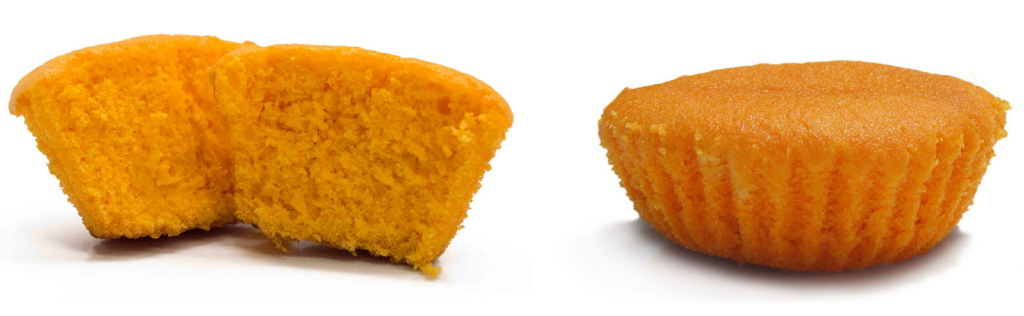
Other ingredients can also cause hue variation when added or removed from the formula. For example, the addition of cocoa powder can affect the color expression of beet color in a Red Velvet cake. The lack of eggs in vegan baked goods or alternative flours in gluten free products can impact the final color, as seen in the below cupcakes.
2. Baking Conditions
Another key factor when choosing a natural color for bakery is knowing the baking and processing conditions. The cook time, temperature, and even the kind of oven used can help determine the best natural colors to choose. Cake and bread applications need colors with excellent heat stability to sustain extended bake times. These include turmeric, Emulsitech® beta-carotene, annatto, class I caramels, and carmine. Cookies and wafers have shorter baking times opening the doors to additional colors like beet.
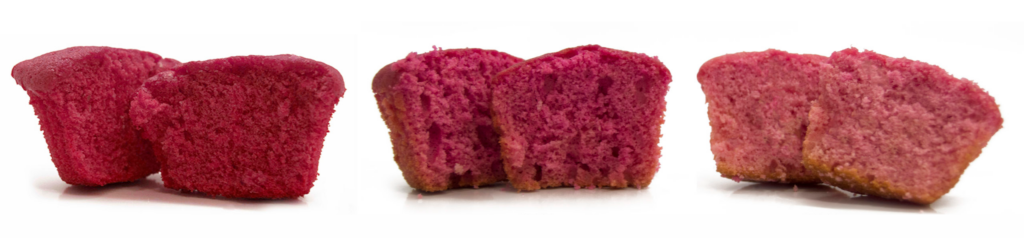
It’s also critical to understand the cooling process and timing of a baked good since some natural colors may fade, like the beet in the cupcake below (right). You can overcome this by overdosing a bit, or adding a little more up front, to offset any color fade that may occur (center cupcake). Even the size of a baked good can cause significant differences. For example, a full sheet cake will have different heating and cooling curves than a cupcake, and that can make all the difference in the final hue of the product.
3. Labeling
Deciding which claims and ingredients you want listed on the label is an important decision that should be made early in product development. Different natural color products can carry different certifications, such as Kosher, Halal, Certified Organic, and non-GMO project verified. By letting us know which certifications you’d like to have on the label, we can help make the right natural color choice. This is also true for how you’d like the color listed on the label, such as ‘Vegetable Juice Color’.
4. Regional Limitations
Understanding regional limitations or parameters for your naturally colored baked good will also help you decide which color to select for your product. Every country has their own regulatory requirements, so it’s important to know where you will be selling your bakery product as this can impact natural color selection.
Some regions have use rate limits for particular color sources. For example, in the EU, there is a legal maximum use rate of carmine in bakery products. Sometimes, manufacturers have restrictions on how much color can be added due to formula limitations, so understanding those limits is important when coloring foods.
5. Packaging, Storage, and Shelf-life
Knowing the potential shelf life of bakery items and how they’ll be displayed or packaged is extremely critical to picking the right natural colors for your products. Will your bakery item be exposed to light? And for how long? Baked goods can be packaged in multiple ways and can have different shelf-life expectations. For example, a cupcake may be expected to look vibrant in a transparent wrapper for a few days, but a cookie may be in a completely opaque bag for several months.
Some colors are more light-stable than others, so this can affect whether your bakery item will look as good on day 5 as it did on day 1. Turmeric is a great heat stable yellow option for baked goods but is not light stable and would require opaque packaging. If your using transparent packaging opt for beta-carotene instead.
Figuring out how to choose the right natural color for your bakery application can be challenging, but when you choose the right one, your brilliant bakes will really shine! Need some help deciding? Contact us with your questions.
Top 5 Considerations When Colouring Confections
With so many different types of natural colours, choosing the right one for your confection application can feel overwhelming. Whether you’re creating a boiled sweet, gummy, panned candy, marshmallow, or chocolate, there are some important factors to consider when choosing a natural colour. We’ve broken down the top 5 considerations when colouring confections to make your colour selection process easier.
1. Processing Conditions
The first thing you’ll need to consider is your product’s processing conditions. Will high heat be involved in the process? When will the colour be added? If your product undergoes a high heat treatment, it’s important to choose a heat stable natural colour. High temperatures during processing can cause certain colours, like spirulina and red beet, to fade. For example, hard candies and lollies are boiled to high temperatures for a long period of time, so make sure to use colours that have high heat stability, such as anthocyanins, beta-carotene, annatto, turmeric, and copper chlorophyll[in].
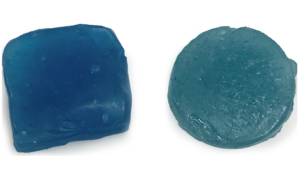
If you need to use colours with lower heat stability, like spirulina or beet, another solution is to add the colour later in the process. For gummies and boiled sweets, adding the colour during the cooling or forming stage helps reduce the chance of colour degradation, as can be seen with the Spirulina in the hard candies below. In general, the later the colour is added to the formulation the better, as it reduces heat exposure to the colour. And be sure to keep in mind that thermal conditions can vary from the lab to production scale.
2. Product Type
Natural colours will behave differently based on the type of confection you’re working with. In a foam product or pulled hard candy, air is incorporated during the process which will reduce the impact of the colour making it appear lighter and less intense. In this case, you’ll need to overdose the colour (or add more colour than you need up front) to compensate for this.
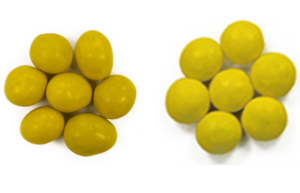
If you’re working with a panned candy, the colour vibrancy of the final product will appear different depending on the base colour. If you pan the colour directly onto a chocolate base, the final colour will appear muted or dull, like in the image below. Panning on a white base layer, though, will allow for the colour to appear more vibrant since the base colour isn’t adding any dark undertones.
When making boiled sweets, the final clarity could be impacted by both the natural color you choose, and the other ingredients present in the mix. Sometimes you might want the boiled sweet to be clear, whereas others may need to have more of an opaque look. If clarity is an important factor to the final look, then choosing the correct natural color is an important consideration.
3. Regional Limitations
Every country has their own regulatory requirements, so it’s important to know where you’ll be selling your confection product as this can impact natural color selection. There may be different requirements depending on the region. For example, safflower is a great bright yellow option for confections in the EU, but it is not permitted as a color in the US. You’ll have to opt for a color like turmeric instead.
Even if a natural color is permitted for use in a certain region, there may still be limitations surrounding how it is used. Chlorophylls are widely used in the EU and Latin America for multiple applications, including confections, but are not permitted in the US outside of dry mix beverages. Other natural colors, such as annatto and carmine, have maximum use limits by specific application types.
4. Product Formulation
The product formulation for your confection will also be important to consider when choosing a color since certain ingredients, like gelling agents, can impact natural colors in different ways. For example, different gelling agents for gummies will result in different base colors and clarity. In the case of copper chlorophyllin, a gelatin-based gummy will appear a dull, cloudy lime shade while a carrageenan-based gummy will be a clear, blue-green shade.
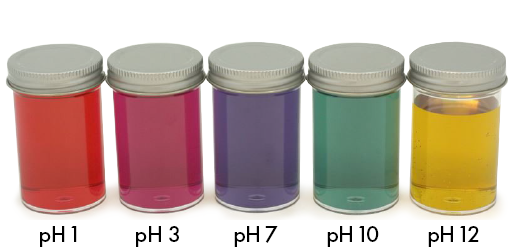
The pH of the system can also affect color. Anthocyanins, like Amaize® red, purple carrot, and elderberry, are pH sensitive colors. This means the hue will shift depending on the pH of the application. If you’re working with a confection at a low pH, such as a gummy or boiled sweet, anthocyanins will appear red. But if you try to use them at a higher pH, like in a marshmallow, the color will turn purple or start to fade.
5. Storage and Packaging
How will your confection be packaged and stored? Packaging and storage conditions will differ based on the kind of confection you’re working with. If your packaging is transparent, it’s best to use more light stable colors, such as carotenes, paprika, luteins, carbon black or anthocyanins. In the case of beta-carotene, the inclusion of ascorbic acid will help to improve its storage conditions.
Lastly, the label claims and positioning of the final product are an important part of color selection. These on-pack claims could require Kosher, Halal, Certified Organic, or non-GM colors and are often region specific. Early planning with these considerations will lead to the correct selection of appropriate colors earlier on in the development process.
Figuring out how to choose the right natural color for your confection application can be difficult, but when you choose the right one, your eye-catching confection will win out above the rest! Need some help deciding? Contact us with your questions.
Webinar: Natural Colours for Petfood
Clean Label Kibble: Formulating Pet Food With Natural Colours
Pet owners want the best diet possible for their furry friends – and that means using ingredients that they recognize and understand. Formulating pet food with natural colours is a great way to simplify labels for dry kibbles, gravies, and baked treats so consumers can feel good about what they’re feeding their pets! In this presentation, we’ll take you through the ins and outs of using natural colours and simple label browns that’ll help make your pet food worth drooling over.
To view the webinar, please fill out the form below.
About the Presenter:
Katie Rountree
Senior Application Scientist for Givaudan Sense Colour in Louisville, KY. Mixing up naturally colourful solutions with a technical twist for over 8 years. BS in Food Science and Human Nutrition, MS in Food, Nutrition, and Culinary Sciences, both from Clemson University. Proud dog mom who loves spoiling her Havanese, Parker.
Why do you ask so many questions?
Why do you ask so many questions?
When you request a natural color sample for your project, we generally start the conversation by asking you some questions. And while some of these may seem a little intrusive, the answers provide important information that help us select/create the best color solution for your product.
Because natural colors can require more technical know-how than synthetics, we need more information so we can get you a color that will not only look great, but also perform well in your application. Details about packaging, other ingredients in the formula, and certifications will all impact color selection.
Below we share some of the most common questions we ask when starting a project and why we ask them.
What limitations does your project have?
The first questions we always ask revolve around limitations: ‘Are there any limitations for your project in terms of cost-in-use, dosage rates, or any “no-no” ingredient lists?’ Not only does this information help narrow down the wide range of colors to choose from, it also provides guidelines so we stay within your project parameters from the get-go and can better meet your expectations.
For example, if you only have room in your product formulation for 0.01% color, we may start with a higher strength color. Or if you need a stable brown but have to comply with a retailer’s ‘simple label’ list, we would suggest one of our Naturbrown® options.
Does your product need to meet any certifications?
Another important consideration are the certifications your product requires. If you product is certified Kosher, Halal, Non-GMO Project Verified, or Organic, for example, the colors you use will also need to have these certifications.
By providing this information at the start of a project, we can narrow down the available colors and only work with ones that fit your requirements.
What can you tell us about your base?
Base formulas are complex, so we spend a lot of time on these questions to make sure we provide a color that makes your product look great and will remain stable throughout its shelf life. Things that we touch on are:
What is the color of your base?
Are you working with a clear or cloudy beverage? Does your meat alternative use soy protein or pea protein? The appearance of a natural color can vary significantly from one base to the next, so understanding what the starting point looks like helps determine the best colors to try.
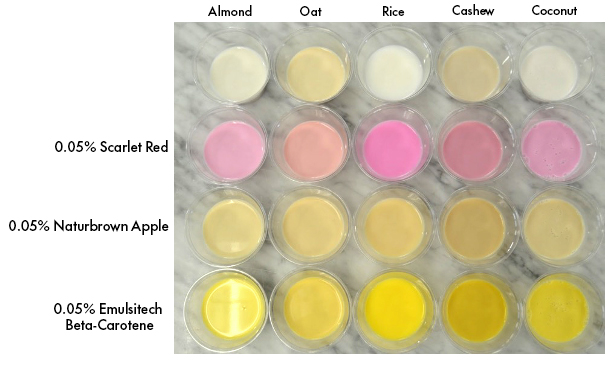
Oat-based beverages, for example, are an off-white cream color while rice-based beverages are brighter white. Additional color or even a different color may be required to overcome the base tones of the oat beverage compared to the lighter rice beverage. The below image shows what three colors at the same usage rates look like in beverages with different base colors.
Going one step further and providing your base for our scientists to work with, can result in an even better color match to your target.
What other ingredients are in your formula?
Ingredients, especially when it comes to beverages, are important to understand when choosing a natural color solution.
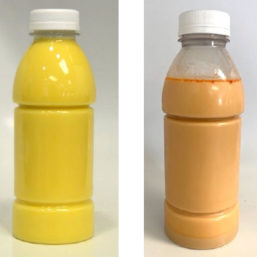
Emulsifiers are a prime example of this. Many beverages contain emulsifiers in their flavor systems. Some natural colors, especially carotenoids like beta-carotene or paprika, also utilize emulsifiers. If the two types of emulsifiers interact, it could result in a broken emulsion and ringing around the top of the beverage as seen in the one below.
What is the pH of your application?
Many natural colors are also sensitive to pH. Anthocyanins like our Amaize® Red, for example, change colors as the pH changes. In a pH 3 sorbet it will appear a nice pink-red shade. But as the pH increases, as in frozen yogurt or ice cream, it will appear more purple.
Other colors, like spirulina or beet, will even precipitate out at a pH below 4. So by providing the pH of your application, we can stay away from colors that won’t stand up to your formulation.
What form of color do you need?
Does your system require a water or oil soluble color? Do you prefer to work with a powder or liquid? Product formulations and manufacturing processes vary greatly, so providing information on the form of color that is easiest to incorporate into your manufacturing process or the type that works best in your formulation helps guide color selection.
What is your manufacturing process like?
Understanding what processing your product will need to endure is critical to suggesting the right color. HTST, baking, and extrusion require colors with high heat stability, for example.
Order of ingredient addition can also play a big role in natural color stability. If you add a color at the beginning of a sugar boil when making confections, you’ll need a more heat stable color than if you add it at the end of the boil. And if you’re able to change the order of ingredient addition, that information helps, too!
How will your product be stored?
Lastly, we ask questions about how your product will be stored. Is your beverage stored ambient or refrigerated? Will container be transparent or opaque?
Turmeric, for example, provides excellent yellow colors for lemon ice cream. But if your ice cream container has a clear window, we’d select our Emulsitech® beta-carotene instead.
Sharing information on how the product will be packaged and stored, as well as your shelf life will result in better color stability over the life of your product.
This is a lot – we know! But at the end of the day, we just want to help you find the best color for your product and the more information we have, the better we can meet your expectations and help you create a beautiful product for your customer.
Ready to get started? Contact us about your next color project.
Color Matching
Color matching is often necessary when customers switch natural color suppliers or move from synthetic to natural colors. In both cases, we need to match the original color as closely as possible. But how do we do this? We’ll show you using the example of replacing Red #40 in confections with natural colors.
Set a target
Color matching starts by measuring the target confection color using a laboratory instrument called a colorimeter. A colorimeter reads the transmittance or reflectance of light from a color sample and produces quantitative measurements for different aspects of the target color. These data are presented as L*a*b*
L* – represents lightness/darkness, where a value of 0 would indicate black and a value of 100 would be white
a* – represents the redness (+ value) or greenness of the sample (- value)
b* – represents the yellowness (+ value) or blueness (- value) in the sample.
Once we have the target sample measured, we record this information as our benchmark.
Use Visual Cues & Quantifiable Data
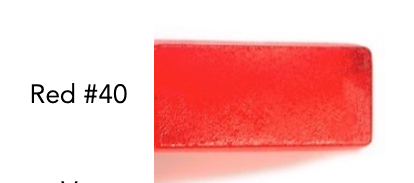
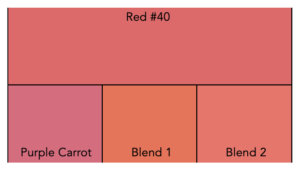
Once we have our target, benchwork can begin. First, we select a variety of natural colors at various dosage levels or create a variety of natural color blends until we have several close visual matches. We know that Red #40 is a bright red color with a hint of yellow. So, to create the blends, we use anthocyanins for the red component, and beta-carotene and turmeric for the yellow components. In order to verify which blend is actually the closest, however, we have to go back to the colorimeter to compare these samples against our benchmark.
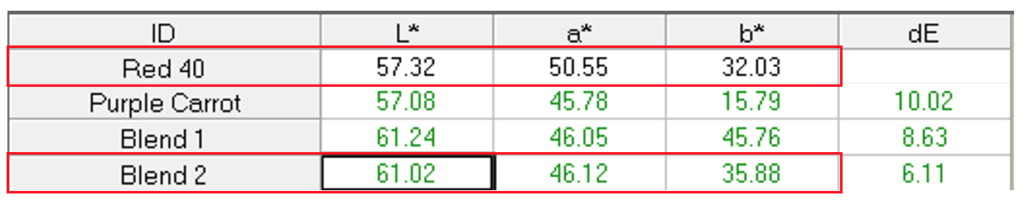
You can see the results of the colorimeter readings below. Of the samples, the L*a*b* values for Blend #2, which contains our Amaize® Red and Emulsitech® Beta-carotene, are the closest to the corresponding values of the target sample. However, it can be confusing to look at each of these values individually. So we typically look at what is called the dE CMC value, which is essentially a sum difference between two sets of L*a* b* values. Simply put, the dE CMC tells us how different two colors appear. The lower, the value the closer the two colors are.
A dE CMC value under 3 indicates that the difference in color is so small it is difficult to detect by the human eye, so a value of 3 or under is our goal for most color matching projects. Blend #2 has the lowest dE CMC with a value of 6.11, meaning it is a good match and the closest out of the three samples to the candy colored with Red #40. But it isn’t quite right yet.
Additional Methods
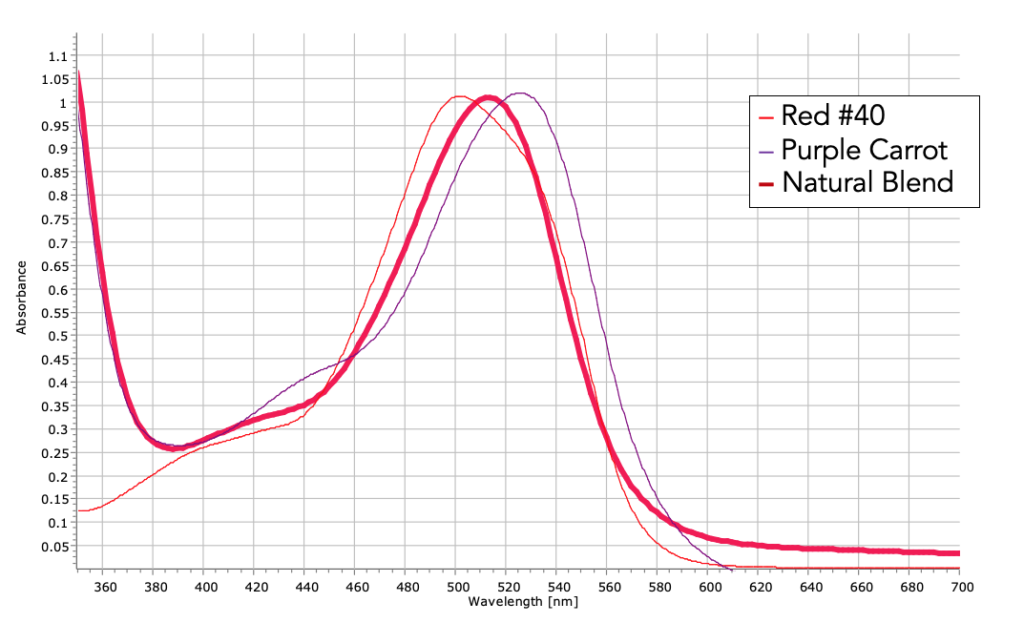
You can also use an instrument called a spectrophotometer – a device used to measure the absorbance of light – to see how close you are getting to your target sample.
The results appear as a graph with a peak. The peak indicates the presence of certain colors by measuring which light wavelengths are absorbed. In the graph below, the bold red line that represents Blend #2 is closer to the peak of the Red #40 candy sample meaning that they have similar absorbance, as opposed to the purple carrot option, who’s peak is further away.
Adjust Blend Ratios & Dosage Levels
To get a closer match, we analyze the colorimeter data to decide which color components may need to be changed in order to attain a closer color match. The a* data tells us that the Red #40 sample has more red while Blend #2 has more yellow. The L* value also tells us that blend 2 is slightly lighter than the Red #40 sample.
Knowing this, we slightly decrease the amount of beta-carotene in the blend to reduce the yellow tones. And by slightly increasing our use rate, we are able to decrease the L* value to darken our color and better align with the Red #40.
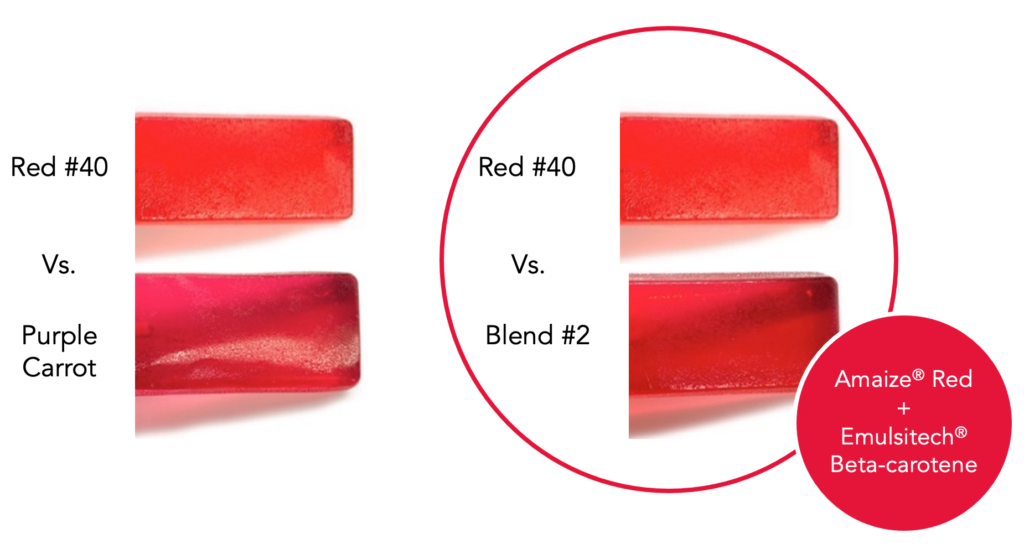
Using instrumental data, visual comparisons, and a lot of experience, we can create color blends to match just about any standard!
Want to see more? Watch the video here.
Or contact us to get started on your color matching project.
Top 5 Considerations When Choosing a Natural Color
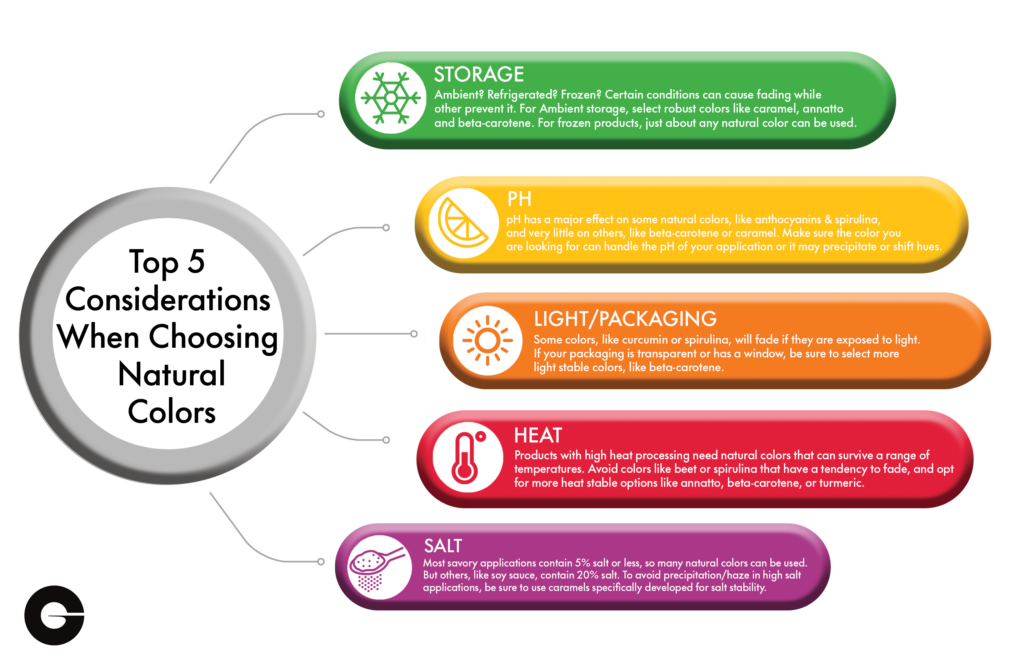
There are hundreds of different types of natural colors from dozens of different sources and choosing the best natural color for your product can seem daunting. So, we’ve selected the top 5 key factors that influence color choice for a specific application. Want a more in-depth look at how to choose the best natural color for your application? Read the full article here.
Choosing the best caramel colour for soy sauce
Soy sauce represents a huge customer sector for caramel color – in Asia, the demand for caramel color for use in soy sauce exceeds that for beverages. The primary purpose of adding caramel to soy sauce is to enhance the color shade. However, it offers additional benefits to soy sauce: it can reduce batch-to-batch variation, improve color adhesion to meat and noodles, and contribute to viscosity and mouthfeel. There are a variety of caramels, each with different hues and viscosities, to suit the needs of each manufacturer.
Color
The two main reasons for adding color to soy sauce are to improve the hue and to create batch-to-batch consistency. Because red-brown hues are typically preferred for soy sauce, choose a red-toned caramel over one that has a yellow-brown tone.
When adding color to improve batch-to-batch consistency rather than improve color tone, go with a caramel that is as close to your target color as possible so you have flexibility with dosage levels depending on the color of the batch. This ensures that consumers always receive a consistent, high quality product
Adhesion
Color adhesion to protein and noodles is extremely important as it allows consumers cooking at home to achieve a bright red-brown savory color in their meals. While class III caramel colors are the most commonly used to color soy sauce due to their red–brown color and salt stability, they are not the best options if the goal is to improve the staining for meat or noodles.
Red-toned class I and IV caramel colors developed specifically for salt stability are generally better options as they can help soy sauce adhere better to protein and noodles.
Viscosity & Mouthfeel
Depending on the region of use, caramel color can also be used to increase the viscosity and improve the mouthfeel of the final product. Some manufacturers add up to 20-30% caramel color to get the right consistency. If this is the main goal, be sure to select a high-viscosity class III caramel color for the best results.
Stability
While color, viscosity, and mouthfeel are all important reasons for coloring soy sauce, they main requirement of a caramel color for soy sauce is that it must be stable in 20% salt solution to even be considered. Caramel colors that are not salt-stable will form a haze in in the sauce and precipitate out. If a soy sauce is highly concentrated (above 20% salt solution), it is best to add the caramel color after the sauce is diluted in order to prevent the color from falling out of suspension.
Ready to get started? Request a sample here.
Caramel Color – What Does it work in?
It works in everything!
Some people just can’t believe how versatile our caramel colors are… We hope this clears things up a little!