
Shelf Life of Natural Colours
Looking at Shelf Life:
Just like any food or food ingredient, colour additives and colouring foodstuffs have a duration window within which they meet their functional specification and remain safe for use.
Quality and safety are two very different aspects that intertwined define the shelf-life of the colour. In this article, we’ll help you take you through the factors that contribute to the shelf-life of a natural colour so you can take the best advantage of their shining performance.
The Storing Conditions are Fundamental
The first thing you should know is that the shelf life is defined for a specific storage condition. It applies to unopened packaging units that have been shipped and stored under the recommended parameters of temperature and other environmental factors expressed in the technical data sheet.
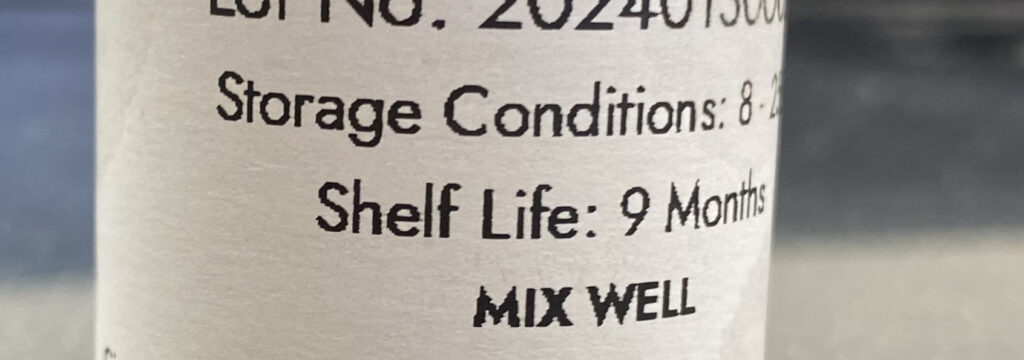
Some of these additional requirements may include keeping the product away from humid settings, strong lights (like the sunlight) and harsh odors. These conditions are typically listed on the outside of the packaging or sample and on the Technical Data Sheet (TDS).
Opening the Package, Opening the Door to Degradation
After a packaging unit is opened, the chemical reactions that lead to colour degradation may occur at a faster rate because the colour gets exposed to light, oxygen, and external manipulation through foreign objects like stirring devices, pump inlet piping or any other measuring recipients used to dose the colour.
How does a natural colour degrade?
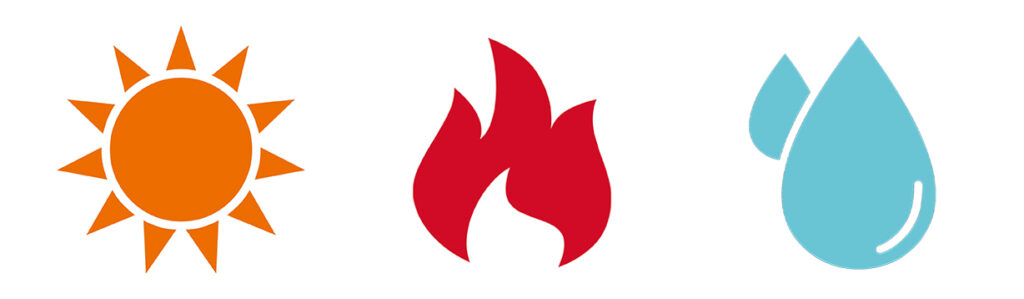
The first thing that can change during degradation is colour strength. The same chemical structures in molecules that absorb preferential wavelengths of light and that are responsible for the colours we see: conjugated double bonds, ring systems, coordination complexes, etc., are prone to be attacked by chemical and physical factors like UV radiation, heat, water (hydrolysis), and other substances in the system.
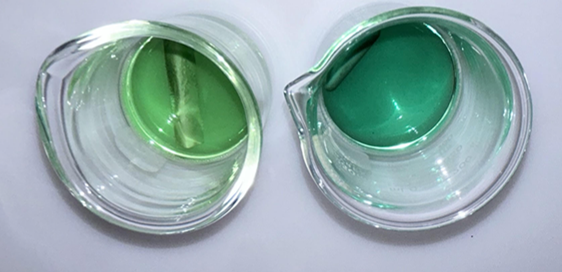
If pigments degrade in living cells by exposure to natural elements (like chlorophyll fading in autumn leaves) pigments that have been extracted from their storing and protective structures are even more fragile. We formulate our colours to optimize stability with strategies like reduced water activity, addition of antioxidants or encapsulation, but at faster or slower rates depending on the nature of the colours the degradation kinetics will take their course and show as a decreasing colour intensity.
As an exception, caramel colours continuously increase their colour intensity, because the caramelization reaction actually never stops, but this also leads to an undesirable increase in viscosity, which makes it difficult to dose and handle.
Other aspects of the colour formulation can also be affected with the passing of time. Oily carriers or co-additives may oxidize causing rancidity and its sensory consequences, and generating free radicals that can increase the rate of degradation of sensible pigments.
If the colours are formulated as emulsions, their stability may be disrupted causing creaming, flocculation, coalescence or Ostwald Ripening. Hygroscopic powders may slowly absorb water from the air (unless with completely airtight packages) causing agglomeration and clumping.
And last but not least, as with most food ingredients, colour additives and specialty colouring foodstuffs have nutrients that may promote microbiological growth.
Proper preventive measures are carried out during product development and manufacturing to reduce to reasonable limits the chances of pathogenic and nonpathogenic microorganisms’ contamination and growth, but while many colour formulations are shelf stable, some others are fermentable and thus have shorter shelf lives and have more stringent requirements for storage and transportation conditions.
So, how do we decide the shelf life of a colour?
Depending on the colour, a typical shelf life is usually between 6 months to 2 years. So how do we determine its useful life?
Aside from considering all the necessary information about the color composition, and deciding the type of packaging and storage conditions, we perform durability studies at lab scale. We do this either through real time testing or with accelerated stability tests based on the previous knowledge and historical data for similar formulation systems.
The takeaway
Natural color companies go to great lengths to design functional, beautiful and safe colours, and make sure to run strict stability testing to determine their durability. We also consider extrinsic aspects like the most appropriate packaging to protect the product, as well as the most adequate temperature and environmental conditions to preserve functionality and suitability for food use.
Technical data sheets included with your colours as well as package labeling will help you find important informational tools about shelf life and storage conditions, so you can plan your demand according to your usage rates and storage space- and especially to get the best results from your valuable natural colours.
If you have any questions about our quality and safety assurance policies, contact us, we’re happy to help.
Is Caramel Color Safe?
Is caramel color safe?
Is caramel color safe? The answer is yes – caramel colors have been deemed safe by all major global food regulatory bodies, including the US Food and Drug Administration (FDA), the Joint FAO/WHO Expert Committee for Food Additives (JECFA), Codex Alimentarius, the European Food Safety Authority (EFSA) and Health Canada. Here’s why:
Background
The question around the safety of caramel color arose when California added a chemical found in class III and IV caramel colors called 4-Methylimidizole, or 4-MEI, to their Prop-65 list. Adding it was based on a controversial study by the National Toxicology Program (NTP) from 2007. The 2-year study on mice showed an increased incidence of certain lung tumors when they consumed 4-MEI. However, the levels of 4-MEI given to the mice far exceeded the normal amount humans would be exposed to when consuming food or beverages – an amount equivalent to a human drinking thousands of cans of cola every single day throughout their life.
What is 4-MEI?
4-MEI is a chemical compound that naturally forms during the cooking of food and beverage items we consume on a regular basis: coffee, cooked meat, baked goods, etc. Since caramel colors are created by cooking sugars, 4-MEI is naturally formed during the manufacture of certain products – specifically class III and IV caramels. 4-MEI is not present in Class I and II caramels and 4-MEI itself is never added to foods or beverages.
4-MEI occurs in very low levels in caramel colors. And since caramel is often used at dosage rates of around 0.1%-2.0% in final products, the occurrence of 4-MEI from caramel color in finished goods is miniscule.
But since it was added to the Prop-65 list, in order to comply with California law, many caramel manufacturers (including us!) began to innovate new methods of cooking class III and IV caramel colors that resulted in even lower levels than already occur, called ‘low 4-MEI’ caramels, some of which have levels so low they can be difficult to detect in the caramel color, let alone the finished product.
Safety Studies
In order to ensure continued consumer safety, many studies on the safety of caramel color and the recommended daily intake levels on 4-MEI have been carried out since the controversial 2007 NTP study was published.
In a review of the scientific literature on 4-MEI, EFSA found that the highest exposure level to 4-MeI that could result from the consumption of foods containing class III and IV caramels “was not concerning.”
Interested in reading more about the safety of caramel color? Check out these resources: