
Shelf Life of Natural Colours
Looking at Shelf Life:
Just like any food or food ingredient, colour additives and colouring foodstuffs have a duration window within which they meet their functional specification and remain safe for use.
Quality and safety are two very different aspects that intertwined define the shelf-life of the colour. In this article, we’ll help you take you through the factors that contribute to the shelf-life of a natural colour so you can take the best advantage of their shining performance.
The Storing Conditions are Fundamental
The first thing you should know is that the shelf life is defined for a specific storage condition. It applies to unopened packaging units that have been shipped and stored under the recommended parameters of temperature and other environmental factors expressed in the technical data sheet.
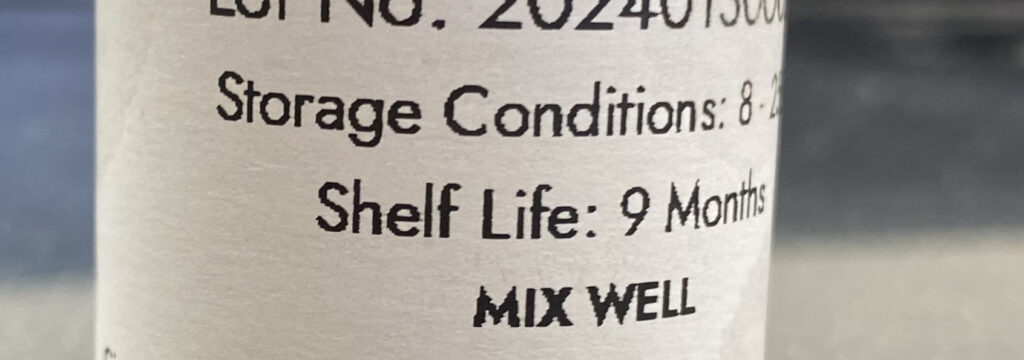
Some of these additional requirements may include keeping the product away from humid settings, strong lights (like the sunlight) and harsh odors. These conditions are typically listed on the outside of the packaging or sample and on the Technical Data Sheet (TDS).
Opening the Package, Opening the Door to Degradation
After a packaging unit is opened, the chemical reactions that lead to colour degradation may occur at a faster rate because the colour gets exposed to light, oxygen, and external manipulation through foreign objects like stirring devices, pump inlet piping or any other measuring recipients used to dose the colour.
How does a natural colour degrade?
The first thing that can change during degradation is colour strength. The same chemical structures in molecules that absorb preferential wavelengths of light and that are responsible for the colours we see: conjugated double bonds, ring systems, coordination complexes, etc., are prone to be attacked by chemical and physical factors like UV radiation, heat, water (hydrolysis), and other substances in the system.
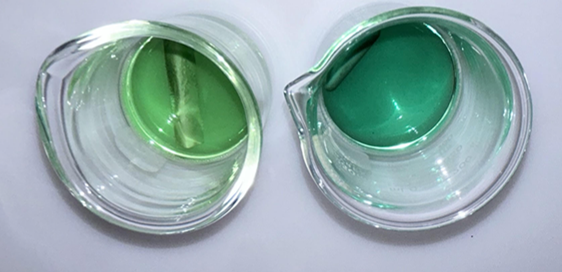
If pigments degrade in living cells by exposure to natural elements (like chlorophyll fading in autumn leaves) pigments that have been extracted from their storing and protective structures are even more fragile. We formulate our colours to optimize stability with strategies like reduced water activity, addition of antioxidants or encapsulation, but at faster or slower rates depending on the nature of the colours the degradation kinetics will take their course and show as a decreasing colour intensity.
As an exception, caramel colours continuously increase their colour intensity, because the caramelization reaction actually never stops, but this also leads to an undesirable increase in viscosity, which makes it difficult to dose and handle.
Other aspects of the colour formulation can also be affected with the passing of time. Oily carriers or co-additives may oxidize causing rancidity and its sensory consequences, and generating free radicals that can increase the rate of degradation of sensible pigments.
If the colours are formulated as emulsions, their stability may be disrupted causing creaming, flocculation, coalescence or Ostwald Ripening. Hygroscopic powders may slowly absorb water from the air (unless with completely airtight packages) causing agglomeration and clumping.
And last but not least, as with most food ingredients, colour additives and specialty colouring foodstuffs have nutrients that may promote microbiological growth.
Proper preventive measures are carried out during product development and manufacturing to reduce to reasonable limits the chances of pathogenic and nonpathogenic microorganisms’ contamination and growth, but while many colour formulations are shelf stable, some others are fermentable and thus have shorter shelf lives and have more stringent requirements for storage and transportation conditions.
So, how do we decide the shelf life of a colour?
Depending on the colour, a typical shelf life is usually between 6 months to 2 years. So how do we determine its useful life?
Aside from considering all the necessary information about the color composition, and deciding the type of packaging and storage conditions, we perform durability studies at lab scale. We do this either through real time testing or with accelerated stability tests based on the previous knowledge and historical data for similar formulation systems.
The takeaway
Natural color companies go to great lengths to design functional, beautiful and safe colours, and make sure to run strict stability testing to determine their durability. We also consider extrinsic aspects like the most appropriate packaging to protect the product, as well as the most adequate temperature and environmental conditions to preserve functionality and suitability for food use.
Technical data sheets included with your colours as well as package labeling will help you find important informational tools about shelf life and storage conditions, so you can plan your demand according to your usage rates and storage space- and especially to get the best results from your valuable natural colours.
If you have any questions about our quality and safety assurance policies, contact us, we’re happy to help.
Natural Color Stability Testing
Natural color stability is a multifaceted question – but critical for guiding customers to the best solution for their food and beverage products.
Many factors affect the stability of natural colors – from the raw material quality, formulation, food processing, storage, supermarket lighting, to cooking by the final consumer. Testing ensures that the processing formulation, and packaging solutions employed are robust and validated.
We’ll share how we test for stability to heat, light, and acid.
Heat stability
It is critical to know the heat stability of natural colors before using them in applications like bakery, confections, extruded products, or beverages where the color will be subjected to high temperatures or periods of extended heat.
There are multiple ways to test heat stability for different applications, but stability is generally determined by incubating the color at a time and temperature similar to the customer’s application. The color is measured using a colorimeter before the test and after being subjected to the heat process to track the impact of time and temperature on the color.
Beverages may be incubated in a hot box or tested in a water bath to see how well the colors perform when pasteurized. Color stability in a baked good, on the other hand, is tested in the oven. Colors that measure within a dE CMC (or total color change) of 3 to the original sample are considered to have excellent heat stability.
Check out the video below to see more in depth how we test the heat stability of natural colors.
Light stability
Light stability in application is the most commonly requested test from customers with translucent or transparent packaging since they need to know if their product will retain the initial vibrancy and shade across the retail shelf life. Check out how we do it in the video below:
The ideal light stability test is a real-time test in the final packaging using the same lighting, e.g., Cool White UV, DE65 artificial sunlight, etc. under which the product will be stored. The test is conducted for the duration of the desired shelf-life of the product.
Under these conditions and with accurate and precise measurements using either absorbance (using a spectrophotometer) or L*,a*,b* (using a colorimeter) the color change can be tracked over time, measuring the product at certain intervals.
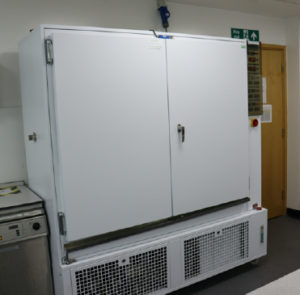
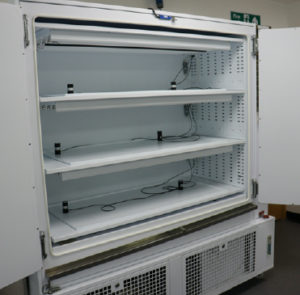
If real time testing is not possible due to a short development or launch window, accelerated light testing is done using high intensity light.
Samples are placed in a photostability cabinet like the one above that is temperature controlled to 25°C (77°F) using illumination that would mimic supermarket conditions. By doing this, we can get general light stability results in 15 hours that would typically take a full year in real time.
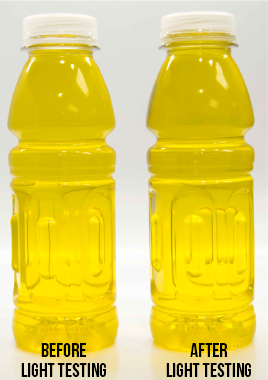
The image below shows Emulsitech® Beta-carotene at a 0.02% use rate that has gone through accelerated light testing. The post-light beverage on the right has a dE CMC of 3.89 from the original, which indicates very good stability.
Acid Stability
Acid stability is another commonly requested test that measures how stable a natural color is at different pH levels and in certain conditions. While this is specific to the customer and the application, a general acid stability test can be performed. Check out the video below featuring our galdieria blue, to see how we check the acid stability of a product.
In this type of test, the natural color is added to solutions at a range of pH levels. The color is then measured and monitored for a set period of time: generally an accelerated test for quick results, or a real-time test for more comprehensive results. If at the end of that time the color has not faded or precipitated, it is generally considered to have good acid stability.
While the key aspects of natural color stability that are checked are the three we talked about here: heat, light, and pH, many other types of stability tests, such as alcohol, salt, or flavor system tolerance can be performed depending on specific products or customer requirements.
Check out the different types of support we offer or contact us to get started.