
Video: Testing the Heat Stability of Natural Colors
How We Test the Heat Stability of Natural Colors
Understanding natural color stability is critical for guiding customers to the best solution for their products. And testing natural colors for heat stability is especially important for applications like beverages, extruded products, and baked good that will be subjected high heat or extended periods of heating.
This video shows how we do a standard 8-week heat test to see how natural colors will perform in beverages.
Interested in learning more about how we test the stability of natural colors? Check out the full article on Natural Color Stability Testing.
Need help testing color stability for your project? Contact us to get started.
Natural Color Stability Testing
Natural color stability is a multifaceted question – but critical for guiding customers to the best solution for their food and beverage products.
Many factors affect the stability of natural colors – from the raw material quality, formulation, food processing, storage, supermarket lighting, to cooking by the final consumer. Testing ensures that the processing formulation, and packaging solutions employed are robust and validated.
We’ll share how we test for stability to heat, light, and acid.
Heat stability
It is critical to know the heat stability of natural colors before using them in applications like bakery, confections, extruded products, or beverages where the color will be subjected to high temperatures or periods of extended heat.
There are multiple ways to test heat stability for different applications, but stability is generally determined by incubating the color at a time and temperature similar to the customer’s application. The color is measured using a colorimeter before the test and after being subjected to the heat process to track the impact of time and temperature on the color.
Beverages may be incubated in a hot box or tested in a water bath to see how well the colors perform when pasteurized. Color stability in a baked good, on the other hand, is tested in the oven. Colors that measure within a dE CMC (or total color change) of 3 to the original sample are considered to have excellent heat stability.
Check out the video below to see more in depth how we test the heat stability of natural colors.
Light stability
Light stability in application is the most commonly requested test from customers with translucent or transparent packaging since they need to know if their product will retain the initial vibrancy and shade across the retail shelf life. Check out how we do it in the video below:
The ideal light stability test is a real-time test in the final packaging using the same lighting, e.g., Cool White UV, DE65 artificial sunlight, etc. under which the product will be stored. The test is conducted for the duration of the desired shelf-life of the product.
Under these conditions and with accurate and precise measurements using either absorbance (using a spectrophotometer) or L*,a*,b* (using a colorimeter) the color change can be tracked over time, measuring the product at certain intervals.
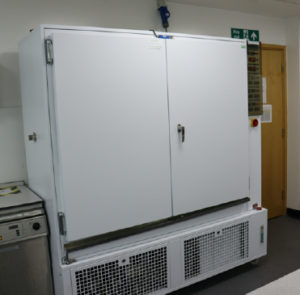
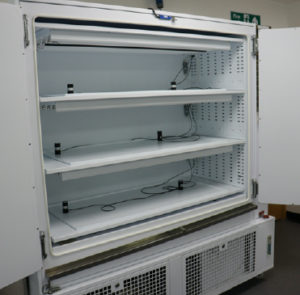
If real time testing is not possible due to a short development or launch window, accelerated light testing is done using high intensity light.
Samples are placed in a photostability cabinet like the one above that is temperature controlled to 25°C (77°F) using illumination that would mimic supermarket conditions. By doing this, we can get general light stability results in 15 hours that would typically take a full year in real time.
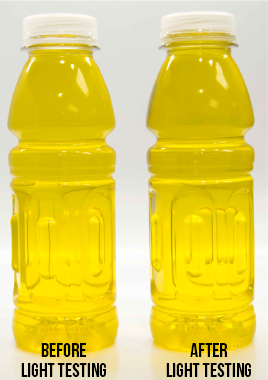
The image below shows Emulsitech® Beta-carotene at a 0.02% use rate that has gone through accelerated light testing. The post-light beverage on the right has a dE CMC of 3.89 from the original, which indicates very good stability.
Acid Stability
Acid stability is another commonly requested test that measures how stable a natural color is at different pH levels and in certain conditions. While this is specific to the customer and the application, a general acid stability test can be performed. Check out the video below featuring our galdieria blue, to see how we check the acid stability of a product.
In this type of test, the natural color is added to solutions at a range of pH levels. The color is then measured and monitored for a set period of time: generally an accelerated test for quick results, or a real-time test for more comprehensive results. If at the end of that time the color has not faded or precipitated, it is generally considered to have good acid stability.
While the key aspects of natural color stability that are checked are the three we talked about here: heat, light, and pH, many other types of stability tests, such as alcohol, salt, or flavor system tolerance can be performed depending on specific products or customer requirements.
Check out the different types of support we offer or contact us to get started.
Alternatives to Carmine
Cochineal and carmine are natural colors extracted from the cactus-dwelling cochineal insect that is native to Latin America. Depending on the method of extraction, they can range in hue from orange to red to purple. They have excellent heat, light, and pH stability and work well in a wide range of applications.
In terms of stability and functionality, these natural colors are some of the best, but because they’re derived from an insect, carmine and cochineal are not considered vegetarian, kosher, or halal. So, for products that need natural colors that comply with these certifications, alternatives to carmine are necessary.
In this article, we’ll go through some of the best alternative options to match the different shades carmine and cochineal provide.
Orange
Annatto, and Paprika provide excellent orange to red-orange shades for many applications. Although they are naturally oil-soluble, yellow and orange emulsions like our Emulsitech® colors provide water soluble options, as well, that are great alternatives to carmine and cochineal.
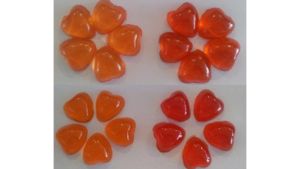
The top row in the image below shows carminic acid used at two different dose levels for light to dark orange shades. The second row shows that close matches are possible with carotenoids, in this case, our Emulsitech® Paprika. While the dosage rate requirements are slightly higher for the darker orange option, it provides heat and light similar compared to carminic acid.
Pink to Red
Beet
Beet is usually the first go-to alternative to carmine for pink to red shades. It has good light stability and an effective cost-in-use. It can also achieve close color matches to carmine in neutral pH applications like dairy beverages and yogurt.
So, why doesn’t everyone just use beet? Beet is notoriously susceptible to fading when exposed to heat. So, while it may work well for certain applications, it may not always survive the heating process associated with applications like strawberry dairy beverages or red velvet cakes.
The image below shows carmine on the left and two dosage levels of beet in cupcakes. The lower dose is not a match to the carmine cupcake and shows significant fading around the edges.
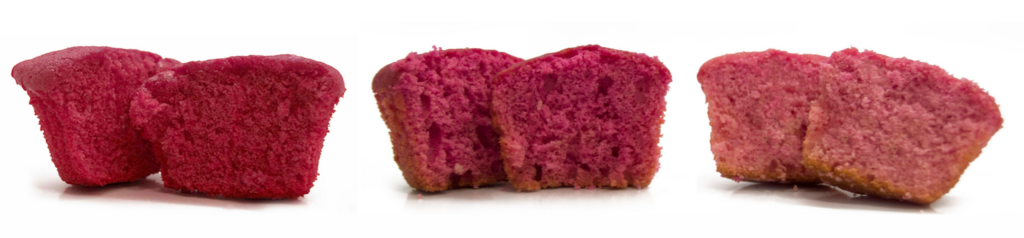
To avoid this, you can overdose a bit to compensate for some of the fading, as seen in the cupcake with the higher dose. But, while the fading is less noticeable and the color is a closer match than the one with the lower dose of beet, doing this requires a much higher dose rate that could result in flavor interference. That is why blends are often a better choice.
Beet is also not the most acid stable red color available, so lower pH applications like beverages, fruit prep, or gummies typically show better results using anthocyanins.
Anthocyanins
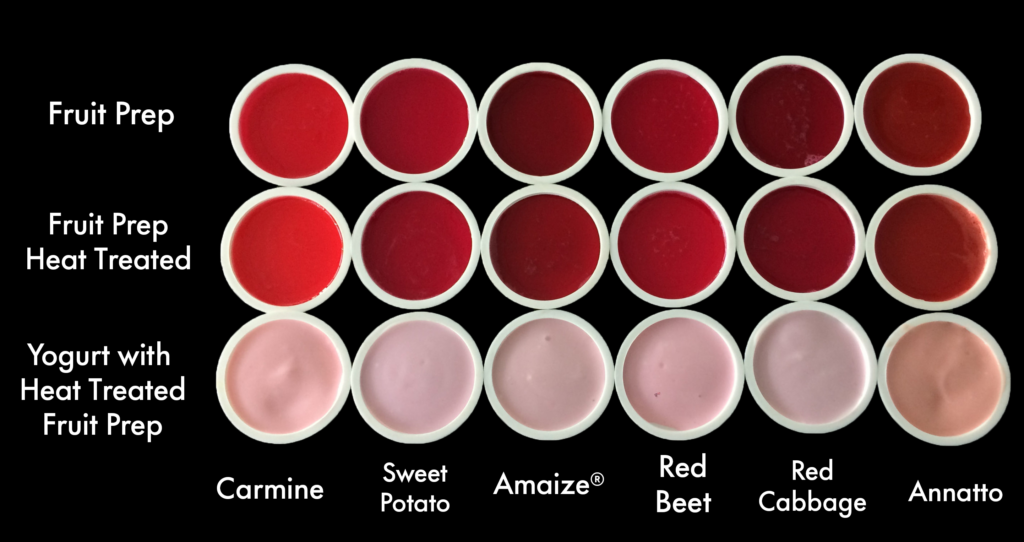
Anthocyanins provide bright red to pink hues in low pH applications. They are also fairly heat and light stable, making them great alternatives to carmine in products like fruit preps, fillings, and low pH beverages.
You can see here that the anthocyanins like purple sweet potato and Amaize® provide similar hues to carmine in fruit prep applications. both before and after heat treatment, the anthocyanins maintain their bright red color.
Blends
Blends will be your best option for replacing carmine when a single natural color alone doesn’t have the best stability or provide the right shade. Beet, for example, can be blended with more heat stable colors like beta-carotene or class I caramels to be used in dairy beverages or bakery applications with better results.
The image below shows carmine in yogurt in the top center row surrounded by a variety of blends using beet, anthocyanins, and beta-carotene at varying dosage levels. By varying the amount of these pigments in the blend, close color matches are possible!
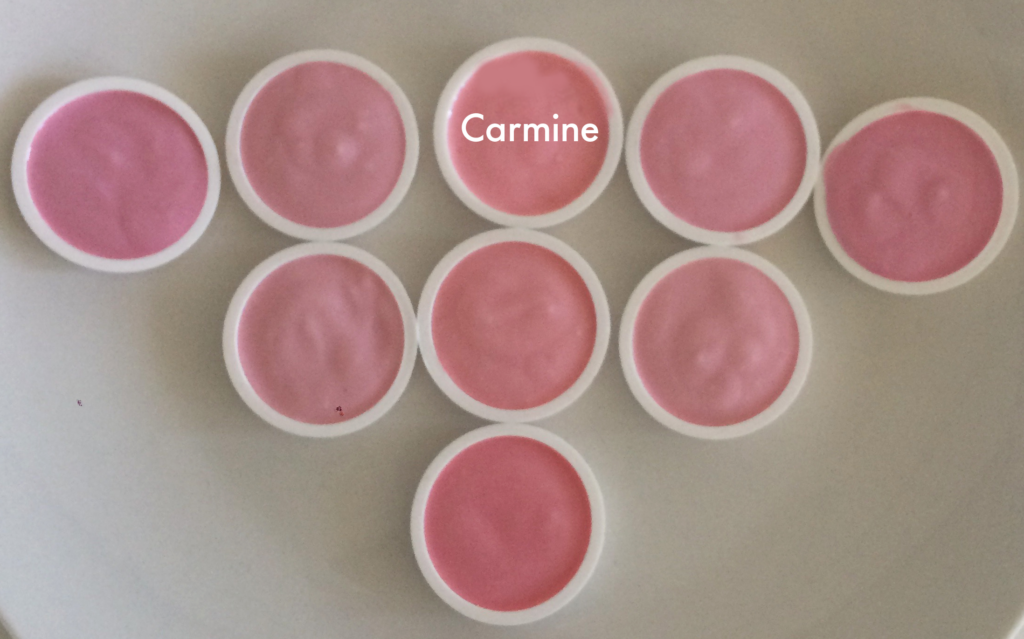
The best way to make sure you are getting the best alternative to carmine for your product is to work directly with our application scientists. By providing your base material and target color, they can try different blends that will meet the stability and color requirements of your product as closely as possible.
Want to see how they do it? Check out our color matching article for the inside scoop. Or get started with a sample.