Switching to Natural Colours in Confections
When you think of confections, you most likely imagine vibrant, colourful shades. To achieve those vivid hues, confections are typically coloured with synthetics, but as consumers lean more toward ‘clean label’ options, demand for switching to natural colours in confections is skyrocketing.
As you start the replacement process, you may hear things like: ‘natural colours aren’t as vibrant as synthetics’ or ‘natural colours aren’t as stable as synthetics’, but don’t fear! Natural colorus can successfully replace synthetic colours in confections. We’ll share some tips to ensure success and bust a few common myths in the article below:
Myth #1: Natural Colors Aren't as Vibrant as Synthetics
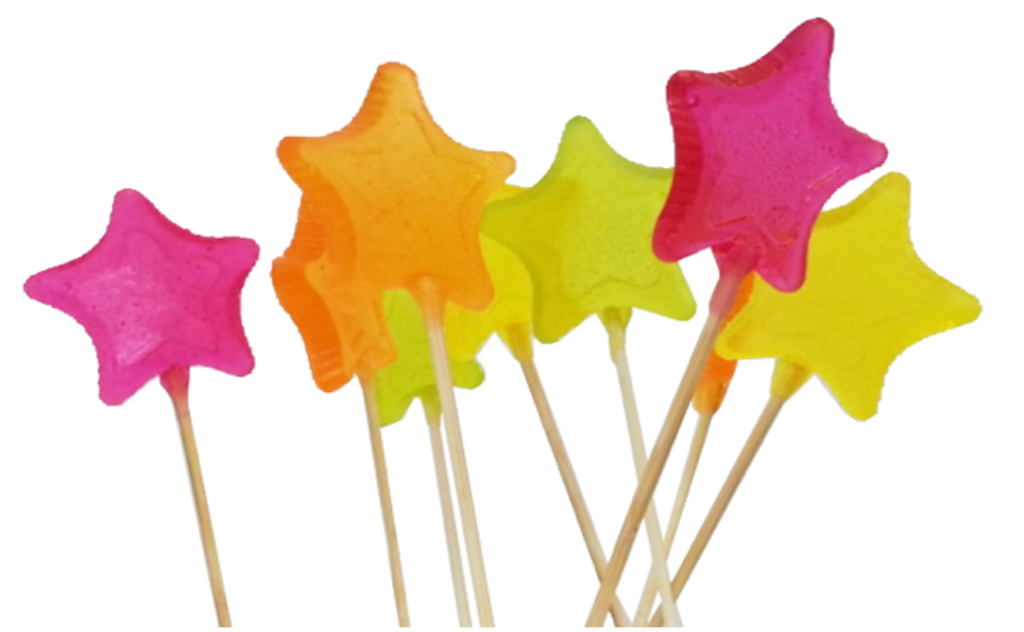
While natural colours may require higher usage rates or care during manufacturing, they can achieve some beautifully bright shades. One reason synthetic colours appear so vibrant is fluorescence. Fluorescent substances, such as Tartrazine, or Yellow #5, absorb radiation at the UV range and reflect it back, sometimes as visible light. Luckily, some natural colours share this fluorescent characteristic. Curcumin, for example, absorbs UV light and blue light and emits back yellow light which is why it appears like it’s glowing under a black light! Natural colours can provide that dramatic, vibrant glowing look, so the fun doesn’t have to be compromised when switching to a natural label.
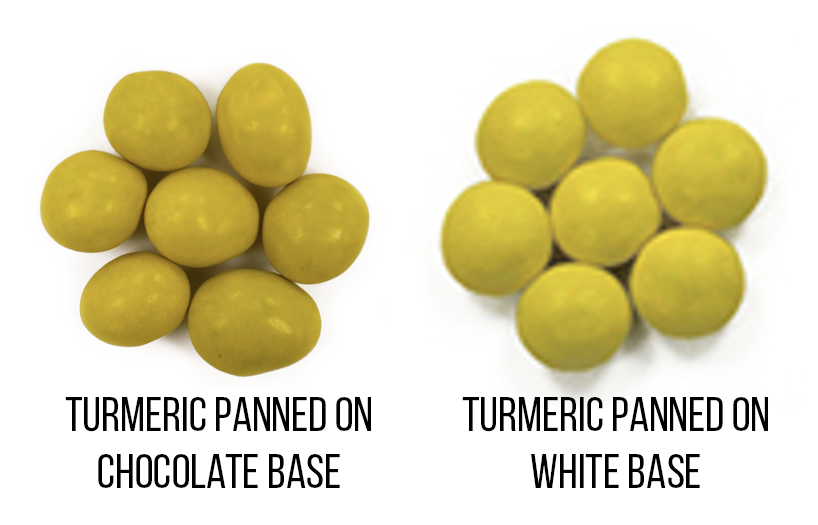
You may also need to adjust when or how you add a natural colour to get the brightest shades. For example, vibrancy can be impacted by the base colour of the confection – turmeric will appear bright yellow in translucent confections like gummies and hard candies, but if it’s used on panned candies, you’ll need to add a white base coating to the chocolate first to give a more reflective background and minimize visual darkness. Otherwise, the colour will appear darker and muted like in the image below.
Myth #2: Natural Colors Aren't as Stable as Synthetics
While synthetics are extremely stable (which is often why companies use them), natural colours can compete – especially in confections! Many confections are in wrappers or opaque envelopes which helps to prevent photodegradation and gummies and hard candies have low water activity, which helps limit colour fade. Gummies are also acidified which is ideal for natural colours like anthocyanins and carminic acid.
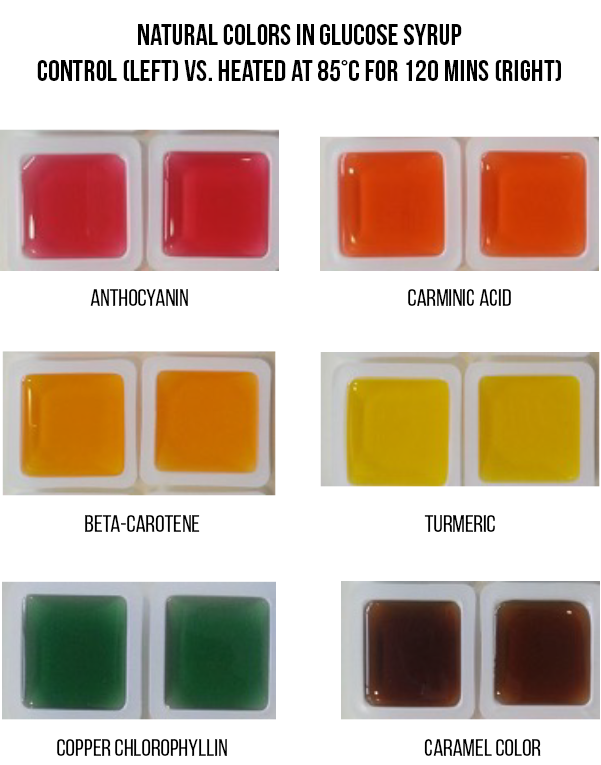
So, the main area of concern is when using natural colours that have lower stability to heat. Some colours are very stable to heat, like those in the image below. But with a slight adjustment in processing colours with lower heat stability, like spirulina and beet, can still be used. In these cases, it is often best to add colours as the sugar mixture is cooling, rather than heating. This will help to prevent any colour fade from heat exposure.
It’s also important to use the best natural color for your specific product when switching to natural colors in confections. This ensures the best stability throughout your product’s shelf life. For example, anthocyanins would provide a stable and bright red in acidified gummies but would turn purple or start to fade in confections with a higher pH such as marshmallows.
Myth #3: Natural Colors Can't Match Synthetics
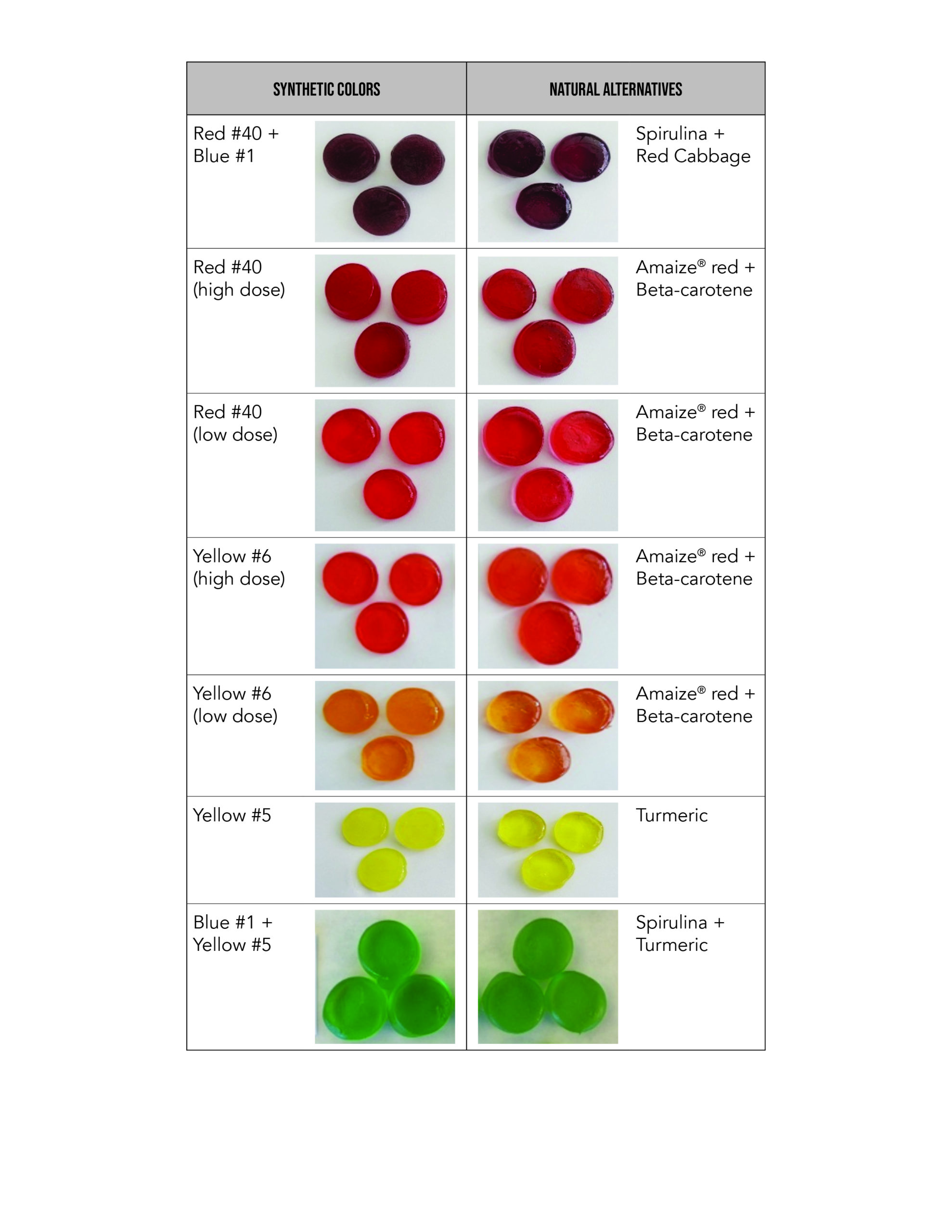
If you’ve historically used synthetic colours and don’t want your end consumer to be surprised by colour changes, don’t worry! Natural colours can closely match synthetics and we are here to help with the process.
To get a good colour match, we start by quantifying the colour using a colorimeter, which measures the transmittance or reflectance of light through a sample and provides measurements for different aspects of colour such as: hue, saturation, and lightness/darkness. We then make up several natural blends and use visual observations to select the ones that appear to be a close match in the application and measure again using the Colorimeter.
In the photo below, you can see a chocolate confection panned with a synthetic color versus our natural match. The colorimeter measurements tell us the hue (h) values are close which means the candies are perceived as the same color. The lightness and chroma values are also close which indicates that the samples are very similar in terms of brightness and saturation – a close color match!
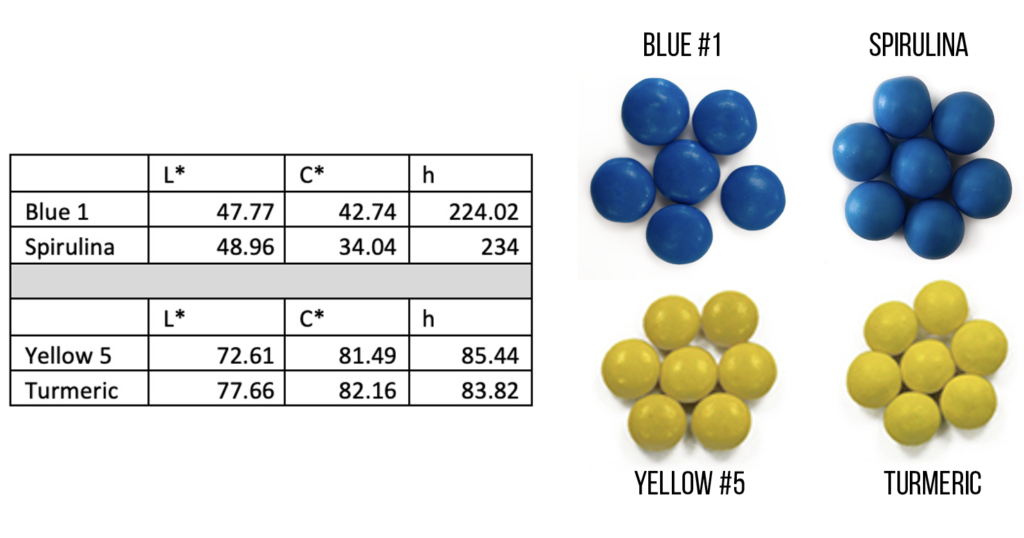
By looking at these measurements we can understand the breakdown of the colour and decide which components may need to be adjusted to get a closer match – i.e. more or less red. Check out our article on colour matching for a more in-depth look at the process!
While these are just the basics for switching to natural colours in confections, all applications are different. Check out our webinar for a more in-depth look at how to replace natural colours in confections. Ready to get started? Request a sample kit or contact us if you have questions on your project.
Webinar: Replacing Synthetic Colours in Confections
Simple label Sweets: Replacing Synthetic Colors with Natural colors in Confections
Formulating confections with natural colours may require more considerations than when using synthetics, but there are plenty of vibrant options to keep your sweets looking great with the simple labels your consumers want. In this webinar, we share some of our best tips for replacing synthetic colours in confections and disprove some common myths about natural colours along the way.
To view the webinar, please fill out the form below.
You can also check out our article on replacing synthetic colors in confections, or jump right in and get started with a natural colours sample kit for confections here!
About the Presenters:
Catalina Ospina
Technical Support – Team leader for DDW, The Color House in Santiago, Chile. Bringing the joy of natural colors to foods and beverages for more than 10 years. BSc in Chemical Engineering and Food Science and Technology Specialist. Foodie by heart.
Kelly Polte
Associate Applications Scientist for DDW, The Color House in Louisville, KY. Blending her colorful, creative side with the technical side of food science. Experience in ice cream manufacturing and sports nutrition. BS in Food Science and Human Nutrition from Clemson University. She likes spending time with her golden retriever, Charlie.
Video: How We Color Match
We often work with customers that are either switching natural color suppliers or moving from synthetic to natural colors. In both cases, we need to match the original color as closely as possible. Our Senior Applications Scientist, Katie Rountree, explains how we do it!
Want a more in-depth look? Read the full article here.
Can You Replace Synthetic Colors with Natural Colors
Of course you can replace synthetic colors! There are natural color options that work for just about every color in just about any application.
However, each natural color has its own distinct properties, so you may not be able to get the exact shade, vibrancy, or stability as you can with a synthetic color. That’s why we often call them ‘natural alternatives’ rather than replacements. Below are some considerations you should take into account if you are interested in switching:
How to do it
1) Determine your objectives
When switching to natural colors, the main objective is usually to create a simple label product for consumers. By replacing synthetic colors with natural alternatives, you can already check that off your list.
Secondary objectives are generally cost or hue driven.
Cost
We’ll be honest – natural colors are more expensive than synthetic colors. But there are many economical natural colors available. If you need low-cost natural color, you may have to compromise on the hue of your product.
Annatto, for example, is a widely used, economical yellow to orange color and can be used to replace Yellow #5 (Tartrazine) at low dosages or Yellow #6 (Sunset Yellow) at higher dosages in many applications. However, it is not always the best match for either synthetic color. Turmeric and Safflower are generally better matches to Yellow #5 while Paprika is a great alternative to Yellow #6, but the cost for these colors can be higher. Blends can get you even closer to synthetic shades but require development time and expertise.
Hue
Alternatively, if your main goal is to match the color and you have some flexibility around cost, you can generally get a very close match because it opens the door to more color options and custom blends. We use a colorimeter, a device that measures color, to determine which natural color or blend give the closest visual match to synthetics in your formulation.
Can you tell which of these panned candies uses natural colors and which uses synthetic? Hover over each image to find out.
Yellow #5
Turmeric
2) Dosage rates
Dosage rates for natural colors are usually much higher than synthetic colors. Typical use rates for natural colors are between 0.1% and 1.0%, depending on the color strength, your formulation, and your target color.
If your product has specific requirements in terms of water content, like white chocolate or compound coating, you’ll need to take that into account when choosing the color intensity and format (liquid or powder) of your natural color. Don’t worry! There are options to suit just about any need.
3) Packaging
You may also have to make decisions on your natural color based on your packaging. Turmeric can be a great alternative to Yellow #5 (Tartrazine), for example. But unlike its synthetic counterpart, it fades when exposed to light.
If your packaging is transparent or has a window and changing it to accommodate the color isn’t an option, beta-carotene is a better choice. While the color is not as close of a match as turmeric, it will stand up much better to light.
4) Manage expectations
While there are many natural color options out there to replace synthetics, an exact color match, usage level, or cost might not be possible with your application. ‘Fluorescent’ or ‘neon’ qualities often associated with synthetic colors are the most difficult to achieve. Knowing your development priorities and what areas you are willing to compromise on, will make for a smooth switch.
An experienced color company should be able to work with you to choose the best natural color to replace synthetic colors for your application. Often, a blend of natural colors is the best solution to balance match, stability, and cost. And the premium price that a clean label product commands easily offsets the cost incurred from switching.
Ready to get started? Contact us for a color consult!
Check out the chart below to see how we matched some common synthetic colors in confections: